Frequently Asked Questions

Our Product

Sunglass Fix operates just like an independent optometrist: we manufacture premium quality replacement lenses shaped to fit your specific frames perfectly, often using higher quality materials than the originals, but at a fraction of the price. We are not affiliated with any sunglass manufacturers.

Cleaning
Daily Wipe: Quickly blow off any dust or dirt, then gently wipe the lenses every time you put them on.

Use the Right Cloth: Always use the provided microfibre cloth or pouch. Do not use paper towels, tissues, or napkins, as the wood fibres in them act like sandpaper and can scratch the lenses.

Warm Soapy Water: For heavy smudges, warm soapy water is best. Standard dishwashing liquid works well, provided it doesn’t contain added moisturisers. Avoid chemical sprays unless they are specialist lens cleaners.

Storage
Use the Case: Lenses are scratch-resistant, not scratch-proof. Always store them in a hard case or pouch when not in use.

Proper Placement: If you put your sunglasses down, make sure they are placed upside down with the arms open. Never place the lenses face down.

Long-term Storage: Thoroughly clean your frames and lenses before storing them for long periods (e.g. over winter) to prevent deterioration.

Additional
Tighten Screws: Periodically check your frame screws with an optical screwdriver. The arms should open smoothly but not drop open under their own weight.

Avoid direct sunlight and heat: While sunglasses are designed for sunlight, prolonged all-day exposure can degrade lenses and cause visual defects. This is especially true if lenses and frames are dirty or wet.

If none of the tips above are helping, don’t throw your favourite shades away. Simply fit a pair of high-quality replacement lenses from Sunglass Fix and enjoy that brand new feeling again.

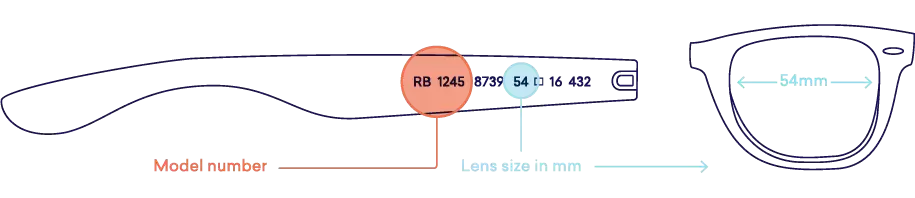
Find your sunglass model number and frame size on the inside of the temple arm to order the right replacement lenses

Most sunglasses can be identified by checking the inside of the temple arm.

  1. Find the Model Number

    Look for a sequence of 4 to 8 characters printed on the inside arm. For example, Ray-Ban frames usually start with "RB" followed by numbers (e.g. RB3025).

  2. Search Efficiently

    When searching our website, keep it simple — less is more. Enter just the core model number (e.g. "3025" or "RB3025") rather than the full string of numbers that may follow. This will give you broader and more accurate results.

  3. Check the Size (Important Step)

    Many brands use the same model number across multiple frame sizes. Check the width: look for two numbers next to a small square icon on the arm (e.g. 55[]18). The first number (55) is the lens width in millimetres. If the markings have worn off, measure the lens width manually to make sure you choose the right size (e.g. 55mm, 58mm, or 62mm).

How you install your lenses depends on the type of frame you have. Work out your frame type below and follow the steps that match.

Full Frame (Plastic/Acetate)
- To Remove: Warm the frame slightly using warm water or leave it in gentle sunlight for a few minutes to soften the material. Find the straightest section of the frame, then push from the back (inside curve) and carefully work the lens out by easing the frame edge away.

- To Install: Start by slotting in the most curved part of the lens first (usually the arm side). Then work your way around the frame, locking in the top edge, followed by the nose bridge. Finish by pressing firmly until the lens pops and seats into place.

Full Frame (Metal)
- To Remove: Locate the small screw near the hinge or tucked behind the temple arm. Loosen it slightly (don’t take it all the way out) so the frame opens and the lens can come free.

- To Install: Line the new lens up in the frame groove, making sure it’s sitting correctly, then tighten the screw again to lock it in.

Half Rim (Nylon Wire)
- To Remove: Hold the lens firmly in place. Push it gently toward the arm side to release tension, then lift the lens up at the nose area until it comes free from the nylon wire.

- To Install: Feed the thin edge of the lens (arm side) into the groove first. Then carefully flex and work the rest of the lens into the frame until it snaps back into place.

If you need a visual walkthrough, check out our Lens Installation Instructions page for step-by-step videos.

Polarised lenses have a special filter that blocks strong reflected light, also known as glare. Unlike standard tinted lenses that just darken your view, polarised lenses filter light to reduce eye strain and improve clarity.

Key Benefits:

  • Safety: Cuts harsh glare from roads, car bonnets, and wet surfaces while driving.
  • Water Sports: Reduces reflection off the water surface so you can see into the water—great for fishing and boating.
  • Reduced Eye Strain: Helps stop squinting in bright conditions, reducing headaches and fatigue.
  • Improved Vision: Many people find polarised lenses give clearer, sharper vision with better contrast and improved colour perception in different environments.

How to Test if Lenses are Polarised:
If you’ve got a phone or computer screen nearby, hold the sunglasses up and look through the lens at the lit screen. Slowly rotate the glasses 90 degrees. If the lens goes dark or black at a certain angle, it is polarised. (This happens because screens also use polarising filters.)

You can read more about polarised lenses and their benefits on our blog.

We use optical-grade polyamide for all of our lenses. This material is lighter, safer, and more impact-resistant than glass, while still delivering excellent optical clarity. We don’t use or sell glass lenses.

Our Lens Tiers:

SFx Diamond-Bio (Premium): Our top-tier lens option. Made from optical-grade polyamide with 44% bio-based content (from renewable castor oil). These lenses include a premium anti-reflective (AR) coating on the back to cut glare, plus a tough hardcoat to help prevent scratches. Available in Onyx, Burnt Umber, and G15 gradients.

SFx Ultra (Polarised): A high-performance lightweight polarised lens designed to seriously reduce glare. They use a Japanese polarising film with a 99.9% efficiency rating. Great for outdoor use, and available in different tints and mirror finishes.

SFx Edge (Non-Polarised): Clear, durable everyday lenses. These have a protective coating to resist water, sweat, and scratching, giving you HD clarity at a fraction of the weight of glass.

Note: All lenses meet ANSI Z80.3-2018 and other regional safety and quality standards, and provide 100% UV protection.

Learn more on our Quality & Colours page.

No, unfortunately The Sunglass Fix cannot make single-piece mask lenses (shields) that cover both eyes. Your frame needs to be designed for two separate lenses (left and right). We’re hoping to offer this option in the future.

If you have a mask-style frame, we recommend reaching out to the original manufacturer for replacement lenses.

Our lenses do not have any branding or logos on them.

Photochromatic lenses automatically adjust their level of darkness based on your exposure to UV light. They contain light-reactive molecules that darken the lens when exposed to bright, direct sunlight and fade back to a lighter resting tint in low-light or overcast conditions.

Key Benefits:

  • Adaptable Shading: Automatically lightens in overcast conditions and darkens in full sun, providing the appropriate amount of shade for your environment.
  • Variable Environments: Ideal for outdoor activities with shifting light conditions—like hiking in and out of tree cover or days with mixed weather.
  • Options: We offer a non-polarized option that transitions from a light 35% base tint up to an 85% dark tint, and a polarised option that starts at a moderately dark 65% base tint and transitions up to 85%.


Important Note on Driving:
The darkening effect requires direct UV light to activate. Because modern car windshields are designed to block almost all UV rays, these lenses will not transition while you are driving. They will remain at their resting base tint inside the car. If you require a maximum dark (85%) lens specifically for driving, a standard tinted lens is a better choice.